
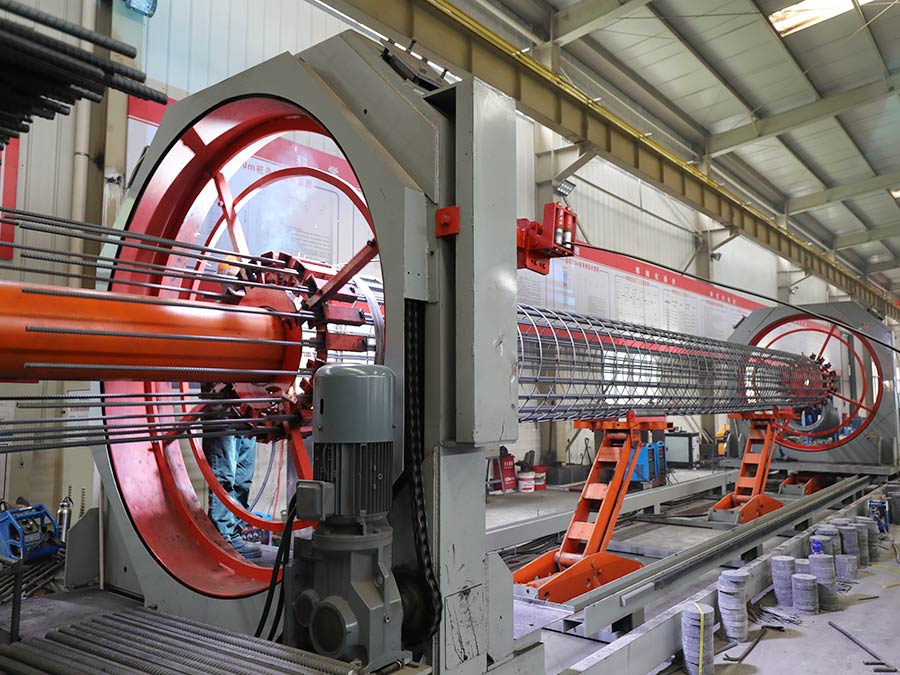
The control system of the reinforcing cage welding machine mainly consists of PLC, HMI, frequency converter and motors. Its main control principle is as follows: the operator edits the drawing of the reinforcing cage to be processed via the touch‑screen (HMI), including setting the total length of the cage and the spacing of stirrups. After editing and sending instructions to the PLC, the PLC controls the travelling of motors and stirrup winding by pulses according to the specified dimensions, so as to automatically complete the processing of the reinforcing cage.
The reinforcing cage welding machine features fast processing speed, high working efficiency, stable and reliable quality of finished products and welding spots, as well as convenient transportation and installation. However, some faults may inevitably occur during daily operation. Below is the troubleshooting guide for common failures of the CNC reinforcing cage welding machine:
Fault 1: Machine stops due to excessive position error between fixed disc and movable disc
Solutions: Check whether the elastic couplings of external encoders on the fixed disc and movable disc are loose, confirm the small chain drive works normally, and inspect whether encoder cables are disconnected.
Fault 2: No response after pressing the "Production Start" button under automatic mode
Solutions: Check whether the wiring of the "Production Start" button is loose, and verify if the home‑return limit switch is triggered.
Fault 3: The carriage fails to reach the home position during returning
Solutions: Check whether the wiring of the "Return" button is loose.
Fault 4: Emergency‑stop alarm
Solutions: Check whether the three emergency‑stop buttons are pressed and not reset, and inspect the emergency‑stop circuit.
Fault 5: Carriage frequency converter reports alarm (ALE09) once the carriage moves after power‑on
Solutions: Check for broken wires and ground short‑circuit of the carriage motor power cable.
Fault 6: Frequency converter reports fault code (ALE11) after power‑on
Solutions: Disconnect the cable of a normally‑working motor and connect it to the faulty frequency converter, then carry out manual test.
‑ If the fault persists: the frequency converter or motor is defective.
‑ If the fault disappears: the original motor cable is broken.
Swap frequency converters for testing.
‑ If the fault remains on the original side: the motor is damaged.
‑ If the fault transfers together with the converter: the frequency converter is damaged.
Fault 7: Communication failure between touch‑screen and PLC (red warning frame displayed)
Solutions: Check whether the power indicator and run indicator of the PLC are normal. If the red fault indicator flashes, an external short‑circuit or PLC damage may exist. Inspect the communication cable, loose connectors and broken solder joints inside plugs. Check whether the ports of PLC and touch‑screen are burnt out.
The above are troubleshooting solutions for common faults. Please feel free to contact us if you encounter unsolvable failures during daily operation of the CNC reinforcing cage welding machine.
| Previous:Operating Precautions for the CNC Rebar Cage Spiral Winding Machine | Next:Operating Precautions for the CNC Rebar Cage Spiral Winding Machine |


 Home
Home
 Products
 Tel
Tel